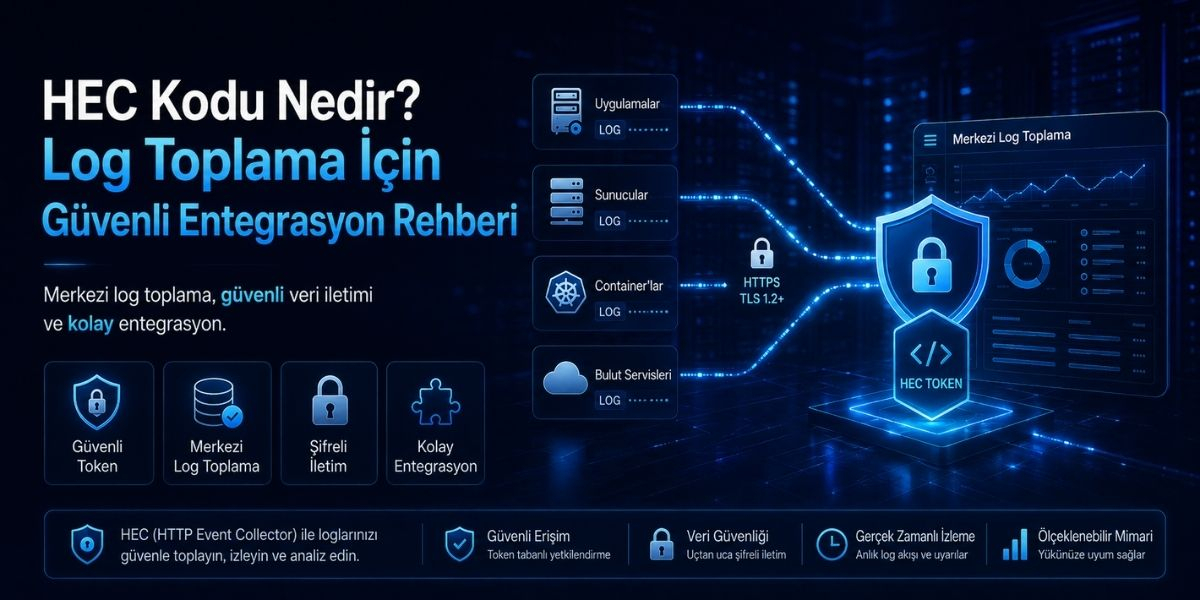
In modern observability and security operations, “hec kodu” is commonly used to refer to an HTTP Event Collector (HEC) token—a credential that allows applications, agents, and integrations to send logs and events over HTTP/HTTPS into a centralized platform (most notably Splunk). HEC is popular because it supports flexible ingestion patterns (structured JSON and raw payloads) and fits well into distributed environments such as VPS/VDS fleets, dedicated servers, container platforms, and multi-datacenter architectures. Splunk documentation describes HEC tokens as unique identifiers used by clients to connect to the HEC input; the token value is a 128-bit number represented as a GUID-like string, which makes guessing impractical when handled correctly. When you treat HEC as a formal “ingestion interface,” it becomes easier to standardize logging across teams, accelerate troubleshooting, and build reliable detection and alerting workflows.
Start by defining how you want to segment ingestion: one token per application/service, per environment (prod/stage/dev), or even per tenant/customer if you run a hosting platform with multiple clients. This segmentation matters because the token is both an authentication mechanism and an operational handle for tracking and auditing who is sending what. Splunk’s guidance frames tokens as the entities that let HTTP clients and logging agents connect to the HEC input, and each token is unique. From a production engineering perspective, you should also decide where events land (index strategy), how you label sources (source/sourcetype conventions), and how you prevent accidental mixing of unrelated telemetry. Getting these decisions right early reduces long-term issues like ambiguous searches, duplicate events, and brittle dashboards that break whenever a new service is added.
A hec kodu/HEC token should be treated like a secret key: if it leaks, an attacker (or a misconfigured system) could inject noisy or malicious events, corrupting your analytics and potentially masking real incidents. The baseline is TLS/HTTPS plus strict network exposure controls—ideally allowing ingestion only from trusted egress IPs, private networks, VPN, or via a reverse proxy/WAF layer that adds rate limiting and abuse prevention. Many HEC deployments listen on TCP 8088 over HTTPS by default, and Splunk examples show HTTPS POST requests with a token included; exposing 8088 directly to the internet without controls is rarely a good idea for hosting-grade systems. In parallel, store tokens in a secret manager (Vault/KMS), platform secrets (e.g., Kubernetes Secrets), or at minimum encrypted configuration, and implement rotation and rapid revocation procedures so the credential lifecycle is actively managed—not forgotten in a config file for years.
Successful log ingestion is not just about delivery; it is about producing events that are searchable, consistent, and analytics-ready. Use a stable field model (service, environment, host, region, severity/level, timestamp, request_id/trace_id) and enforce it across your stacks so that queries and detections remain reusable. Splunk provides reference examples for how events should be formatted and sent to HEC, which you can use as the foundation for an internal standard. In hosting and infrastructure contexts, you often ingest heterogeneous sources—web access logs, application errors, database slow queries, firewall/WAF events—each with different structures. A clear “normalize and enrich” strategy (before ingestion via collectors, or after ingestion via parsing rules) will reduce false positives, improve correlation, and support both performance engineering and security investigations with higher confidence.
After configuration, validate ingestion end-to-end: send a test event with the token, confirm it lands in the correct index, verify timestamps are accurate, and track HTTP response codes so failures are visible. Splunk documentation includes cURL-based examples for sending events to HEC, which are ideal for runbooks and automated deployment validation. Then operationalize monitoring: measure throughput, error rates (4xx/5xx), latency, queueing/backpressure, and downstream license or indexing constraints. In real hosting environments, spikes happen—traffic surges, DDoS windows, batch jobs—and those are precisely the moments when logs become most valuable. To reduce the risk of data loss, use buffering collectors, retry policies, and sensible backpressure handling, and consider sampling strategies for ultra-high-volume streams while keeping security-relevant events intact.
When implemented correctly, hec kodu (HEC token)–based ingestion delivers a scalable and auditable pathway for centralized logs: faster root-cause analysis, better incident response, stronger evidence trails, and clearer performance visibility as you grow. The primary risk is credential misuse—leaked tokens, overly broad network exposure, and weak lifecycle management—leading to data pollution, misleading analytics, and reduced trust in alerts and dashboards. Treat HEC as a production interface: secure transport, strict access controls, secret storage, rotation, revocation, and continuous monitoring must work together. With that discipline, you get a robust ingestion foundation that remains stable as your infrastructure expands across servers, regions, and customer workloads.
Is “hec kodu” the same as HEX (hexadecimal)?
Not necessarily. In logging contexts it usually refers to an HEC token for HTTP Event Collector, while HEX is a base-16 numbering system. Always confirm the context.
What format is a Splunk HEC token?
Splunk describes it as a unique 128-bit value represented as a GUID-like string (commonly 32 characters).
Which port does HEC typically use?
Common deployments receive HEC traffic over HTTPS on TCP 8088, though architectures can place HEC behind proxies with different endpoints.
What should I do if my HEC token is exposed?
Revoke the token immediately, issue a new one, rotate secrets in all clients, tighten network allowlists, and review ingested events for signs of injection or data pollution.
How many tokens should I use in a multi-service hosting environment?
A practical best practice is per-service (or per-service-group) and per-environment tokens, with stricter segmentation for high-risk or customer-isolated workloads.

 Turkey (Türkçe)