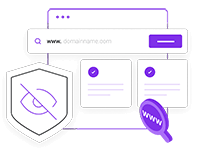
Whois lookup is a service that allows you to access information about who owns a domain name, when it was registered, its expiration date, and which registrar it’s registered with. It’s a useful tool to find out whether a domain is available or already taken.
Instantly access domain registration information. Find out the owner's name, registration date, expiration date, and more in seconds.

All Whois data is updated in real-time, ensuring you get the most current and accurate information.
Whois lookup provides a wide range of details, from domain ownership to technical contacts and administrative information.
With our easy-to-use interface, you can quickly perform Whois lookups and access the information you need with just one click.
At Web9, we're here for you whenever you need us. We resolve any issues you encounter with your domain name, hosting, or server services as quickly as possible. Our experienced support team is available 24/7 via phone, email, and live chat.
We answer all your questions about domain name whois search here. If you have any further questions, you can also contact our customer support team.

Whois is a lookup system that shows who owns a domain name, which registrar it was registered with, when it was created and when it will expire. With a Whois lookup you can see details such as the domain owner, registration date, last update date, nameserver (NS) information and the registrar of the domain. It is especially important to run a domain Whois lookup before buying a domain to check its history and overall trustworthiness.
When you perform a Whois lookup, you can see the domain’s registration date, expiry date, registrar name, nameserver addresses, domain status (active, on hold, etc.) and, if it is not hidden, the domain owner’s contact information (name / company name, email, address, phone). For some extensions (like .com, .net, .org) detailed domain Whois information is available, while for some country-code extensions the information shown may be more limited.
By default, for many domain extensions, Whois information is stored in a public database. This is done to ensure legal and technical transparency for domain ownership. The contact details shown in a Whois lookup allow you to prove that the domain belongs to you and make it possible to contact you in case of rights violations or abuse reports. However, to protect your personal data, you can use a “Whois privacy / ID protection” service to anonymize most of this information.
Whois privacy (ID Protection) replaces your name, address, email and phone number with anonymized contact details provided by your registrar when someone performs a domain Whois lookup. This significantly reduces the risk of spam emails, unwanted phone calls or malicious actors reaching your personal data. Using Whois privacy does not harm your SEO; it simply protects the domain owner’s personal information.
No. A Whois lookup only displays information from a database that is already kept open by registries and registrars. Searching for your domain in a Whois service does not create any new security vulnerability. However, if you are not using Whois privacy, remember that your contact details can be viewed by anyone. For personal domains or small business domains, using Whois privacy is strongly recommended for security and privacy.
Your domain’s Whois information is managed through the registrar (domain provider) where you registered or transferred the domain. You need to log in to your customer panel and go to the “domain management” or “contact details” section to update your registrant, admin, technical and billing contact information. The changes usually appear in Whois lookup results within a few minutes to a few hours, depending on the extension. Incorrect or incomplete Whois data may cause issues and, for some extensions, may even lead to your domain being suspended.
The Whois lookup itself does not directly impact your website’s SEO performance. However, having accurate, consistent and legal Whois information can help build overall trust. Search engines may indirectly consider signals such as a domain’s age, renewal length, clean history and use of a reputable registrar. Using Whois privacy (ID Protection) does not cause an SEO penalty; it only hides personal contact details from public view.
For .tr domains (.com.tr, .net.tr, .org.tr, etc.), Whois policies are defined according to NIC.TR / TRABIS rules and local regulations. Because of this, .tr domain Whois results may show different fields or a more limited set of information compared to global extensions like .com or .net. In some cases, only the organization name or certain fields are displayed. This is a standard applied for both security and personal data protection reasons.
The Whois database is updated automatically whenever a domain is registered, renewed, transferred or when its contact details are modified. On most platforms these updates are almost real-time and visible in a Whois lookup within a few minutes. However, for some domain extensions, registry-side delays can occur and it may take a few hours for all Whois servers to show the latest information.
Your personal data can be largely anonymized by using a Whois privacy service, but certain core registration details must always exist in the system for legal and technical reasons. For generic top-level domains (like .com Whois, .net Whois), your personal contact data can be replaced by proxy information from your registrar. For some country-code extensions, certain fields may always remain partially visible due to local regulations. So Whois data is not deleted, but it can be masked to show only the minimum necessary information to the public.
Yes. You can use the contact details obtained from a domain Whois lookup to reach out to the current owner and make an offer. This is a common method to try to purchase a domain name that is already registered. However, using this information to send spam, bulk emails or harassing messages is against the law and against personal data protection rules. Before reaching out, it’s also a good idea to check domain marketplaces and official sales platforms to see if the domain is already listed for sale.
Most Whois lookup services are completely free and allow visitors to check as many domains as they want. However, some registries and registrars may temporarily rate-limit very frequent Whois queries from the same IP address to prevent abuse or automated scraping. For a normal user doing standard domain owner lookup and basic domain research, these limits are rarely an issue.